


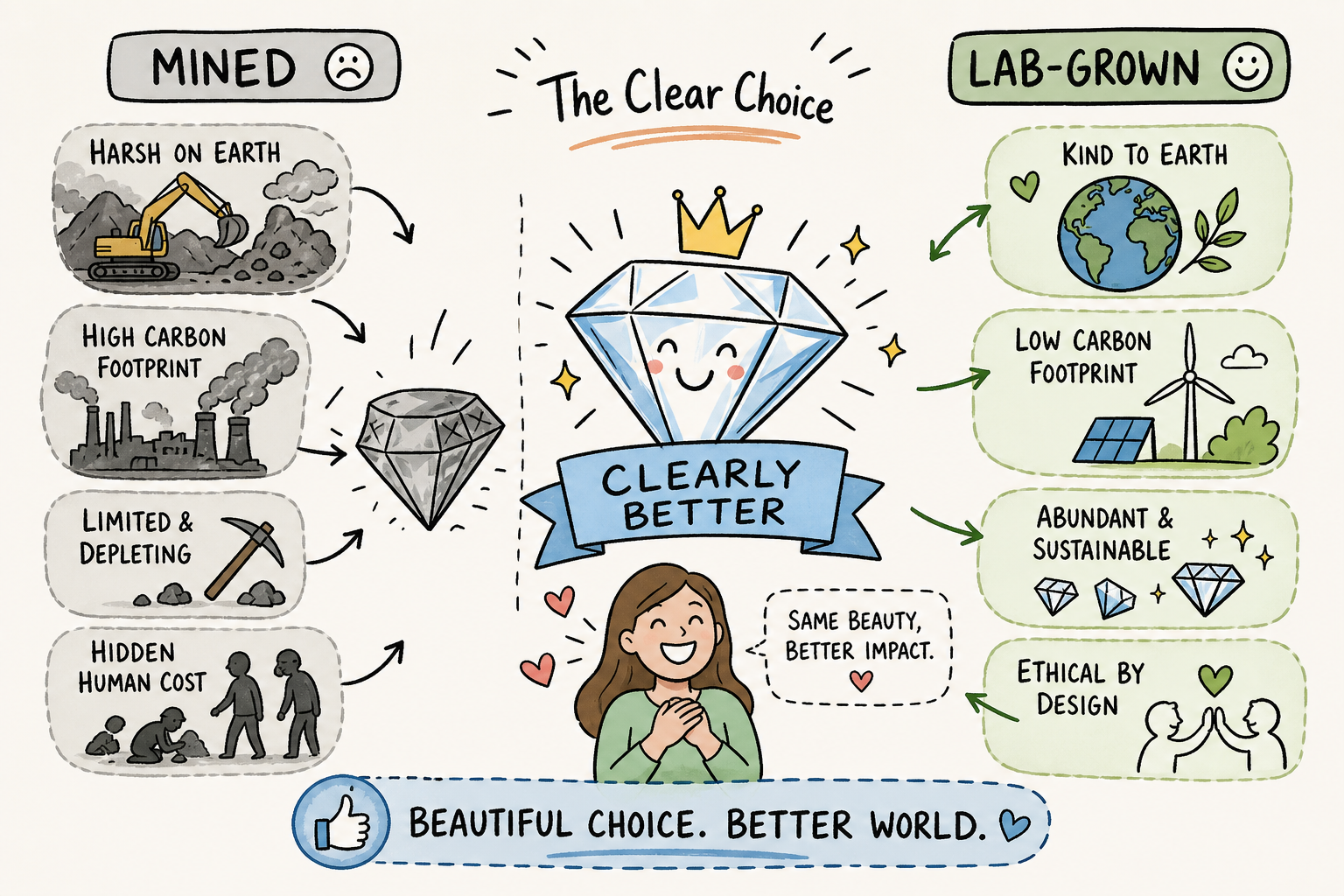
Why should I choose a lab-grown diamond over a mined diamond? It's one of the most common questions couples ask when they start shopping for an engagement ring, and in 2026, it's more relevant than ever. You want a beautiful diamond, but paying $5,000 or more for something available at a fraction of that price is a hard sell. That tension is exactly where most engagement ring conversations start. The good news is that the answer isn't one-size-fits-all, and getting it right is simpler than you might think.
After years of helping couples design rings through the Ring Builder at Nura Lab, the same five questions come up repeatedly: Is it real? Is it worth it? What happens to the value? How ethical is it really? And what should I actually look for on a certificate? This article answers all five, honestly, so you can make the decision that's right for you, not just the one that makes a good marketing headline.
The price gap is bigger than most people expect
In 2026, lab-grown diamonds — sometimes called lab-created diamonds or cultured diamonds — are typically 60 to 80 percent cheaper than mined diamonds of comparable quality. Put that in real terms: a 1-carat mined diamond often retails between $4,000 and $6,000 NZD, while a comparable lab-grown stone runs closer to $800 to $1,500. That's not a small difference. For most buyers, it's the difference between an average ring and an exceptional one.
This isn't a quality compromise. It's a supply chain difference. Lab-grown diamonds can be produced in weeks using either CVD (Chemical Vapour Deposition) or HPHT (High Pressure High Temperature) methods, rather than forming over billions of years underground and requiring large-scale excavation to retrieve. The production cost is simply lower, and that saving passes through to you.
What the savings look like on a real ring budget
On a $3,000 NZD budget, a mined diamond will get you roughly a 0.4- to 0.5-carat stone in a basic gold setting with limited room to move on quality. The same budget with a lab-grown stone gets you a 1.2- to 1.5-carat diamond with room to choose a better cut, a solid 18K gold or platinum setting, and money left over.
Why lab-grown prices have dropped so sharply since 2021
A 2-carat lab-grown diamond that retailed for $6,000 to $8,000 NZD in 2021 now sells for around $1,200 to $1,500. That's the effect of CVD and HPHT production scaling rapidly, with more facilities coming online and technology becoming more efficient. For readers who want the market perspective on changing prices, see a current analysis of lab-grown diamond prices in 2026. The upside for buyers shopping now is obvious. The implication for resale is covered below.
Are lab-grown diamonds actually real diamonds?
Yes. Fully and without qualification. Lab-grown diamonds — whether CVD or HPHT, whether called synthetic diamonds or cultured diamonds in older literature — are chemically and physically identical to mined diamonds: same carbon crystal structure, same hardness (10 on the Mohs scale), same optical properties, same fire and brilliance. The only difference is origin. One formed deep in the earth over billions of years; the other was grown in a controlled facility over a few weeks. A gemologist with specialist equipment can distinguish them by looking for trace element differences and growth patterns, but no jeweller, partner, or guest at your wedding can. For an accessible deep-dive on the chemical and physical similarities between lab-grown and natural diamonds, this overview is helpful.
What the grading reports say (and how GIA and IGI differ)
Both GIA and IGI certify lab-grown diamonds, and both are reputable. The difference worth knowing is this: GIA uses broader descriptive terms for colour on lab-grown reports, such as "Colorless" or "Near-Colorless", rather than the letter grades (D, E, F) used for mined stones. IGI issues reports with a distinctive yellow border for lab-grown diamonds and typically notes the growth method — either CVD or HPHT — directly on the certificate. If you see "AS GROWN" on an IGI report, it means no post-growth treatment or colour enhancement was applied.
For a comparison of major grading reports, see a primer on IGI vs AGS/GIA grading differences.
What buyers should verify on any diamond certificate
Before committing to any stone, check five things:
- Confirm the stone is explicitly identified as laboratory grown, not merely graded without an origin statement.
- Check that the report number on the certificate matches the laser inscription on the diamond's girdle.
- Look for the growth method disclosure — CVD or HPHT.
- Confirm whether any post-growth treatment was applied ("AS GROWN" means none).
- Evaluate the cut grade carefully. Cut determines how much the diamond sparkles more than any other factor, including colour and clarity.
Why choose a lab-grown diamond over a mined diamond for ethical reasons?
The environmental story around lab-grown diamonds is genuinely better in most respects. Buyers deserve the nuanced version rather than marketing copy, so here's where the real differences lie.
On land disturbance and ecosystem impact, lab-grown wins clearly. Production happens entirely within a facility. There's no open-pit excavation, no community displacement, no tailings contamination, and no large-scale habitat destruction. Conventional diamond mining moves enormous volumes of earth — large-scale kimberlite operations can disturb hundreds of hectares — and the social and environmental consequences can persist for decades after a mine closes.
Land, water, and ecosystem impact compared
Mining typically uses significantly more water than lab production and creates contaminated runoff through tailings processing. Lab-grown facilities use water for cooling and industrial processes, but at a much lower scale and without the same contamination risk. For buyers who care about where their stone came from and what its production displaced, the land and water comparison is not close.
The CO₂ question and what "ethical" sourcing really means
CO₂ output from lab-grown diamonds depends heavily on the electricity source powering the facility. A lab running on renewable energy produces a fraction of the emissions of a coal-powered one. The right question isn't just "lab or mined?" but "how was this stone produced and by whom?" For context on differing carbon footprints and how they can be benchmarked, see an industry discussion of the carbon footprints for natural and lab-grown diamonds.
On conflict-free sourcing, every certified lab-grown diamond has a documented, traceable origin by definition. The Kimberley Process governs mined diamond sourcing, but it has recognised gaps — it does not cover artisanal and small-scale mining operations, which account for a significant share of production in some regions — and full chain-of-custody traceability remains difficult to guarantee.
The honest truth about resale value
Most jewellery brands skip this section. We won't. Lab-grown diamonds do not hold their value the way mined diamonds do. Typical resale offers for lab-grown stones run 10 to 30 percent of original retail. Mined diamonds generally fetch 20 to 60 percent depending on quality, certification, and market conditions. That gap is real and you should know about it before you buy. For a focused look at how resale expectations are shifting, read about lab-grown diamond resale worth in 2026.
Here's the context that matters, though. Mined diamonds also lose significant value when resold, often more than people expect. Because lab-grown diamonds cost so much less upfront, the absolute dollar loss is frequently smaller even when the percentage loss is higher.
What lab-grown resale actually looks like in 2026
A lab-grown engagement ring bought for $1,500 NZD may resell for $150 to $450. A mined stone bought for $6,000 may resell for $1,800 to $3,600. The percentage loss is broadly similar; the dollar loss on the mined stone is far larger.
When resale matters and when it doesn't
Most buyers fall into one of two camps. The majority — whether sentimental buyers who plan to wear the ring for decades, or value-focused buyers who want the best stone for their budget — don't need to weigh resale heavily at all. For them, the lab-grown calculation is straightforward. A smaller group purchases with genuine resale intent, and for those buyers, neither lab-grown nor mined diamonds perform particularly well as financial instruments compared with other asset classes. If that's you, read the next section carefully.
When a mined diamond still makes sense
A good jeweller tells the full story. Not every buyer is the right fit for a lab-grown diamond, and acknowledging that is what makes advice trustworthy rather than transactional.
The rarity and heirloom argument
For buyers who place deep significance on geological rarity, the narrative of a stone that formed over a billion years underground carries irreplaceable emotional weight. That meaning is real and legitimate. If the origin story matters to you or your partner at a fundamental level, a mined diamond honours that in a way no laboratory-grown stone can replicate. Heirloom and estate collectors feel this most strongly, and they're right to.
Buyers who prioritise the secondary market
If you're purchasing a stone with genuine resale intent, mined performs better on secondary markets in both percentage terms and buyer appetite. In New Zealand and Australia, the secondary market for lab-grown diamonds remains thin in 2026, with many dealers declining to buy back lab-grown stones at all. If the ring will need to be liquidated at some point, that matters.
Why choose a lab-grown diamond over a mined diamond, and how to buy with confidence
Roughly 47 to 61 percent of engagement ring buyers globally are now choosing lab-grown stones. If you're among them, buying with confidence comes down to what you verify before any purchase. Revisiting the checklist from the certification section above, one point deserves extra emphasis: cut quality above all else. A perfectly cut 1-carat stone outsparkles a poorly cut 1.5-carat one. Colour and clarity matter, but cut is what you'll see every day.
A quick reminder on certification
IGI and GIA are both reliable for lab-grown grading. IGI is the most common for lab-created diamonds and its yellow-bordered reports are easy to identify. Always match the report number to the laser inscription on the girdle — if these don't align, walk away.
Where Nura Lab fits into your decision
If you've decided a lab-grown engagement ring is right for you, the Nura Lab Ring Builder is the most practical starting point. Every stone in the collection is IGI-certified, with transparent sourcing, growth method disclosure, and pricing that reflects what lab-grown diamonds should cost in 2026. Starting from $1,499 NZD, you choose your stone and your setting separately, with free ring customisation, free resizing, and a lifetime warranty included. Real support from people who have spent years doing this is part of the process — no pressure to know everything upfront.
The bottom line
So, why should you choose a lab-grown diamond over a mined diamond? For most buyers, the case is clear. Lab-grown diamonds are real diamonds. They cost 60 to 80 percent less than mined stones of comparable quality. They carry a cleaner ethical record on land use, water, and conflict-free sourcing. They offer the same cut, colour, and clarity options as anything you'd find in a traditional jeweller's case. The trade-off is resale value, and for most buyers, that trade-off is straightforwardly worth making.
Choosing a lab-grown diamond isn't settling for less. It's deciding that the stone on your finger — and what it represents — matters more than how it was extracted from the earth. If you're ready to see what your budget actually gets you, start with the Nura Lab Ring Builder and build the ring you want.


