
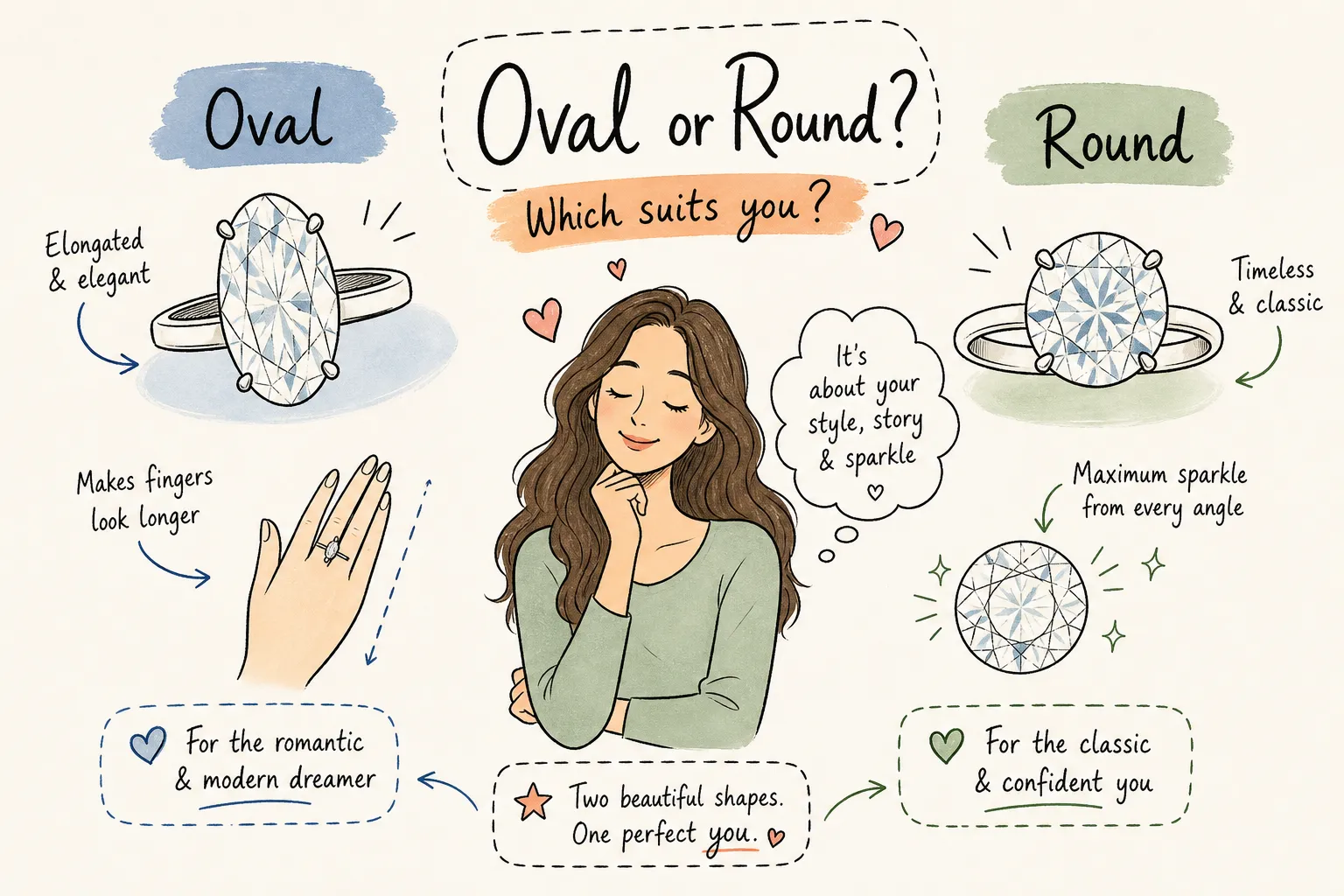
Choosing an oval vs round diamond ring comes down to your hand shape, your budget, and what the ring needs to feel like worn every single day. You've narrowed your search to two shapes and now you're stuck. Both are beautiful. Both are classics. And almost everything you read online either picks a side without real justification or lists the same surface-level facts you already know. The truth is, there's no universally correct answer. The right choice depends on your finger, your spend, and the kind of presence you want on your hand.
Before committing to either shape, try placing both an oval and a round stone into the same setting using Nura Lab's Ring Builder at nuralab.co.nz. For most people, that one visual exercise resolves the debate faster than any written comparison. But if you want the full picture before you start designing, here's what you actually need to know: how each shape reads on the hand, how brilliance differs, what the price gap means in practice, and which settings flatter each shape best.
Oval vs Round Diamond Ring: How Each Shape Looks on Your Hand
Surface area and the size illusion
At the same carat weight, an oval diamond shows roughly 10 to 15% more visible surface area face-up than a round. Published estimates vary depending on the proportions of each individual stone, but as a general guide, a 1-carat round sits at approximately 33 mm² face-up compared to around 36 to 38 mm² for a 1-carat oval. That difference isn't dramatic when you see it written as numbers, but on a hand, it reads as a noticeably larger-looking stone.
The practical implication is meaningful: an oval of around 0.9 ct can look visually similar face-up to a 1.0 ct round. For a deeper look, check out this visual comparison of 1-carat oval vs round diamonds.
The finger-lengthening effect
An oval set north-south on the finger creates an elongated line that visually stretches the hand. This slimming effect is genuinely noticeable, particularly on shorter or wider fingers. A round diamond reads as compact and centred, which suits a wide range of finger shapes well, but it doesn't create the same illusion of length.
Sparkle, Size, and Price
Why round brilliants set the benchmark
The round brilliant is the only diamond shape to receive a standardised cut grade from major grading laboratories such as GIA. This geometry has been refined over many years specifically to maximise light return, fire, and scintillation. It's the most reliable single proxy for top-tier brilliance available in any diamond purchase.
How well-cut ovals compare
Ovals are brilliant-style cuts and can be very lively, but their light performance varies more between individual stones. GIA does not assign an overall cut grade to oval diamonds; reports include polish and symmetry but no single cut score. Look for a length-to-width ratio between 1.40 and 1.45 and a depth of roughly 58 to 62% for optimal beauty. Read more in GIA's oval cut guide.
The bow-tie effect: what it is and how to minimise it
The bow-tie is a dark shadow across the centre of an oval diamond caused by light leaking. The goal is to find a stone where it's subtle and non-distracting. Ratios above 1.50 tend to make this more pronounced. For tips on avoiding this, view this guide on the bow-tie effect.
Price Per Carat: What the Cost Difference Means
Natural Diamonds
Round diamonds require more rough stone to be discarded during cutting, driving up the per-carat price. For natural diamonds, ovals typically cost around 15 to 25% less per carat than comparable rounds.
Lab-Grown Diamonds
For lab-grown diamonds, the pricing dynamic is different. Right now, lab-grown ovals tend to sit slightly above rounds at the 1-carat mark. If you're buying lab-grown, the decision should rest primarily on aesthetics and fit. You can compare our range at Oval Lab Grown Diamond Engagement Rings NZ.
Settings that Flatter Each Shape
- Round Diamonds: Paired naturally with classic solitaires, halos for extra size, or modern bezel settings.
- Oval Diamonds: Excel in halo settings to amplify their length, three-stone settings for a substantial presence, or sleek north-south solitaires.
Discover more in our Ring Settings Guide.
A Short Checklist to Lock in Your Choice
- Choose round if: You want maximum, consistent brilliance and a timeless silhouette.
- Choose oval if: You want a larger face-up appearance and a finger-lengthening effect.
- The golden rule: Cut quality matters more than shape. A well-cut oval outperforms a poorly cut round every time.
Ready to see the difference? Visit our Oval vs Round Engagement Rings Comparison and use the Ring Builder to start designing at nuralab.co.nz.


