


Moissanite vs lab grown diamond is one of the most common comparisons for couples choosing an engagement ring in New Zealand. Both can offer exceptional sparkle, excellent durability and a laboratory-created origin, but they are not the same gemstone.
A lab-grown diamond is a real diamond grown in a controlled laboratory environment rather than mined from the earth. Moissanite is a different gemstone made from silicon carbide, known for its intense brilliance, colourful fire and accessible price.
So which should you choose? The answer depends on whether you value the traditional appearance and material properties of diamond, or whether maximum sparkle and value are higher priorities.
You can explore Nura Lab's lab grown diamond engagement rings and moissanite engagement rings in NZ while you compare the differences below.
Moissanite vs Lab Grown Diamond: Quick Comparison
| Feature | Moissanite | Lab Grown Diamond |
|---|---|---|
| Material | Silicon carbide | Crystalline carbon — diamond |
| Is it a diamond? | No | Yes |
| Sparkle | Strong fire with noticeable rainbow flashes | Classic diamond brilliance, fire and scintillation |
| Mohs hardness | Approximately 9.25 | 10 |
| Price | Generally more affordable | Generally higher than moissanite |
| Independent grading | Varies by supplier | Frequently independently graded |
| Best for | Maximum sparkle and value | Buyers who specifically want a real diamond |
What Is the Main Difference Between Moissanite and Lab Grown Diamonds?
The most important difference is simple: lab-grown diamonds are diamonds, while moissanite is a different gemstone.
Laboratory-grown diamonds have the same fundamental carbon crystal structure as natural diamonds. The Gemological Institute of America explains the difference between moissanite, diamond simulants and laboratory-grown diamonds and notes that laboratory-grown diamonds have nearly the same chemical, optical and physical properties as natural diamonds.
Moissanite, meanwhile, is silicon carbide. It is a genuine gemstone in its own right rather than a type of diamond.
For a deeper introduction to each stone, read our Moissanite Education Guide and Lab Grown Diamond Education Guide.
Do Lab Grown Diamonds Look Like Natural Diamonds?
Yes. A properly cut lab-grown diamond can look the same as a natural diamond of comparable cut, colour and clarity because both materials are diamond.
According to GIA's comparison of natural and laboratory-grown diamonds, the differences between them can be subtle enough that specialised equipment and gemological expertise are required to reliably determine origin.
This is very different from moissanite. While a well-cut moissanite can have a diamond-like appearance, its optical characteristics create a different type of sparkle.
Learn more in our guide: What Are Lab-Grown Diamonds and How Do They Compare?
Moissanite vs Lab Grown Diamond Sparkle
One of the easiest ways to notice the difference between moissanite and diamond is the way each stone interacts with light.
Lab Grown Diamond Sparkle
Lab-grown diamonds produce the brilliance, fire and scintillation associated with natural diamonds. A well-cut diamond tends to show a mixture of bright white light, contrast and coloured flashes as the stone moves.
Moissanite Sparkle
Moissanite is famous for particularly strong fire, meaning you may notice more colourful rainbow flashes when the stone moves under bright lighting.
Some people love that lively appearance. Others prefer the more traditional visual character of diamond. Neither is inherently better — they simply produce different optical effects.
If you are particularly interested in moissanite, read our NZ Buyer's Guide to Moissanite Engagement Rings.
Does Moissanite Look Fake Next to a Diamond?
Moissanite is not a fake gemstone. It is a real gemstone with its own chemical composition and optical properties.
However, it should not be sold or described as a diamond. When viewed beside a diamond, particularly in larger sizes and strong lighting, the difference in fire and sparkle may become more noticeable.
If your priority is having a stone that is actually diamond and closely matches the traditional appearance of a natural diamond, a lab-grown diamond is the more suitable option.
If you simply love an exceptionally bright gemstone and do not care whether the centre stone is technically a diamond, moissanite can offer excellent value.
Which Is More Durable: Moissanite or Lab Grown Diamond?
Both gemstones are suitable for engagement rings designed for regular wear.
- Lab-grown diamond: 10 on the Mohs hardness scale.
- Moissanite: approximately 9.25 on the Mohs hardness scale.
Hardness refers primarily to resistance to scratching. Because diamond is the hardest naturally occurring material on the Mohs scale, it offers exceptional resistance to abrasion.
Moissanite is also extremely hard and is one of the more durable gemstones available for fine jewellery.
Keep in mind that hard does not mean indestructible. Diamonds, moissanite and other gemstones can still chip or suffer damage if struck in the wrong place, and the security of the ring setting also matters.
Does Moissanite Get Cloudy Over Time?
Quality moissanite does not permanently become cloudy simply because it gets older.
As with diamonds, oils, hand cream, soap and everyday residue can build up on the surface and temporarily reduce its sparkle. Regular jewellery cleaning can restore its appearance.
The same is true for a lab-grown diamond. Keeping either gemstone clean — and periodically checking the setting — is more important than worrying about the stone losing its inherent sparkle.
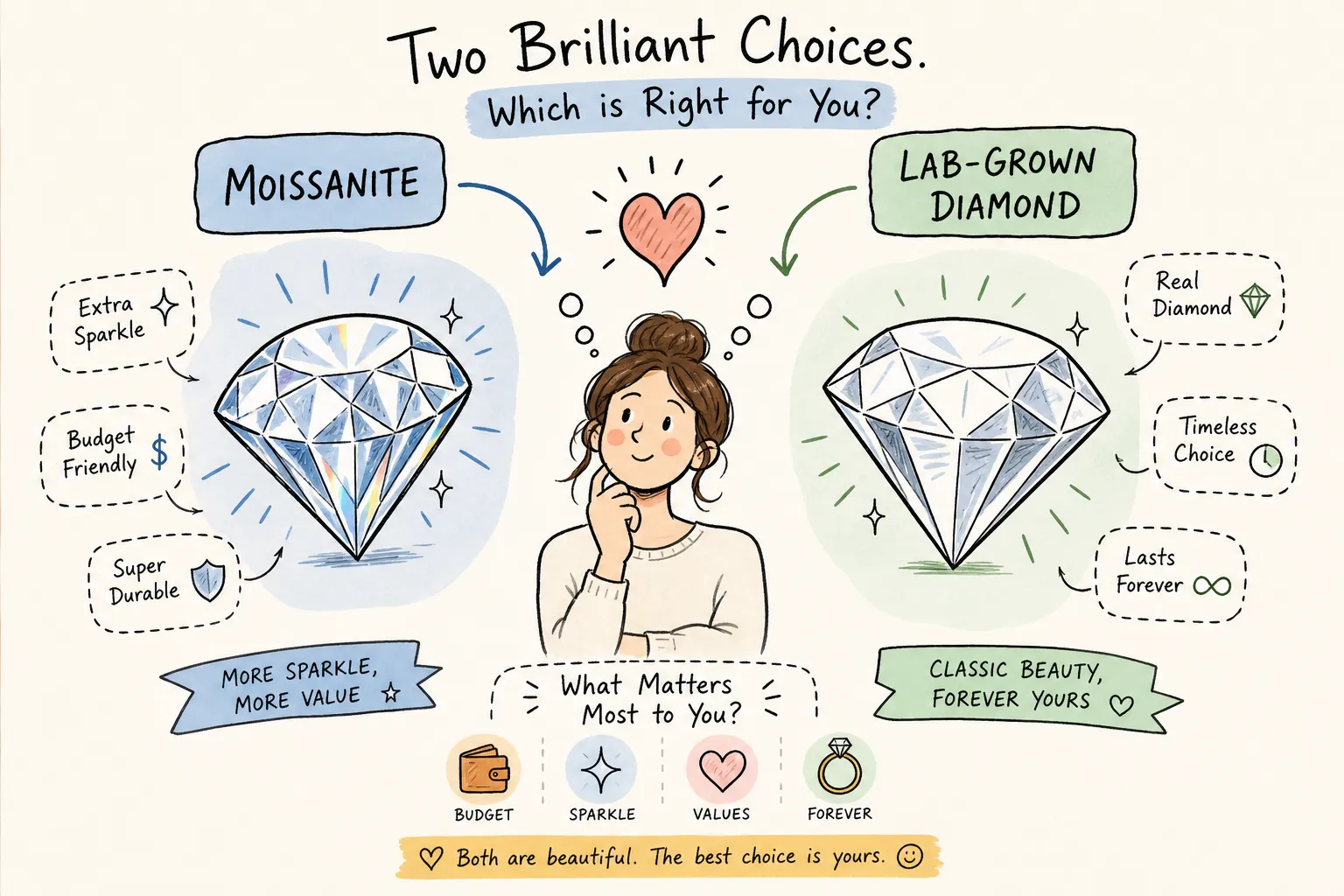
Moissanite vs Lab Grown Diamond Price in New Zealand
In general, moissanite costs less than a comparable lab-grown diamond, particularly when you are looking for a large centre stone.
However, it is better to compare complete rings than rely on generic price-per-carat charts. The final cost of an engagement ring also depends on:
- Centre stone size
- Diamond colour and clarity
- Cut and proportions
- Ring setting
- Side stones
- 9K, 14K or 18K gold
- Platinum
- Custom design requirements
You can compare current Nura Lab pricing by viewing our moissanite engagement rings alongside our lab grown diamond engagement rings.
Choosing moissanite can also leave more of your budget available for platinum, higher-carat gold or a more detailed setting. If you are deciding between metals as well, see our guide to yellow gold, white gold, rose gold and platinum engagement rings.
Moissanite vs Lab Diamond Certification
Independent grading is another important difference to understand.
Quality lab-grown diamonds are frequently supplied with independent laboratory reports documenting characteristics such as measurements, colour, clarity, cutting characteristics and laboratory-grown origin.
The International Gemological Institute's lab-grown diamond reports provide independent identification and grading information for laboratory-grown diamonds.
At Nura Lab, many of our lab-grown centre diamonds are independently graded, giving buyers clear information about the stone they are purchasing.
Moissanite certification is less standardised across the jewellery industry. For moissanite, focus on the quality of the stone, cut, colour, clarity, supplier transparency and the quality of the finished ring rather than assuming a certificate alone guarantees beauty.
For more information about evaluating diamonds, read How to Identify the Best Quality Lab-Grown Diamonds.
Which Looks Bigger: Moissanite or Lab Grown Diamond?
This question is slightly misleading because moissanite and diamonds are not normally compared by weight in exactly the same way.
Diamonds are traditionally sold by carat weight. Moissanite is often marketed using millimetre dimensions or a diamond-equivalent size because its density differs from diamond.
What matters most on the hand is the stone's face-up dimensions. If two stones measure approximately the same length and width, they can provide similar visual coverage even though their actual weights differ.
Moissanite vs Lab Grown Diamond for Large Engagement Rings
The difference between the two options can become more noticeable as centre stone size increases.
Larger moissanite stones can display particularly strong rainbow fire. For buyers who love maximum sparkle and want a substantial centre stone without dramatically increasing the budget, this can be very appealing.
Buyers looking for a large ring while retaining the appearance and material characteristics of diamond may prefer a larger lab-grown diamond.
Nura Lab offers lab-grown diamonds across a broad range of carat sizes, including statement designs. Browse our lab diamond engagement ring collection to compare current options.
Are Moissanite and Lab Grown Diamonds Ethical?
Both can provide an alternative to a mined centre stone because they are created in controlled manufacturing environments rather than extracted from a diamond mine.
However, terms such as ethical, sustainable and eco-friendly should not be treated as automatic simply because a gemstone is laboratory-created.
Environmental impact can depend on factors such as energy sources, manufacturing efficiency, cutting, transport, metal sourcing and the wider jewellery supply chain.
Buyers who care about responsible jewellery should therefore consider the entire ring rather than focusing only on where the centre stone was formed.
Which Is Better for an Engagement Ring?
Both moissanite and lab-grown diamonds are durable enough for an engagement ring. The better choice comes down to what you actually want from the centre stone.
Choose a Lab Grown Diamond If:
- You specifically want a real diamond.
- You prefer the traditional visual character of diamond.
- You want an independently graded centre stone.
- You value diamond's hardness and long-term scratch resistance.
- You want the appearance of a natural diamond without choosing a mined centre stone.
Choose Moissanite If:
- You want to keep the overall ring budget lower.
- You love intense, colourful fire and sparkle.
- You want more visual size for your budget.
- You do not specifically need your centre stone to be a diamond.
- You want a highly durable gemstone suitable for regular wear.
Designing Your Moissanite or Lab Grown Diamond Ring
Your choice of centre stone is only one part of the ring. Shape, setting, metal and proportions all affect how the finished piece looks on the hand.
Nura Lab's Ring Builder lets you begin with a setting and personalise your engagement ring around the look you want.
You can also browse all engagement rings in NZ before deciding which gemstone and style suits you best.
Moissanite vs Lab Grown Diamond: The Final Verdict
If you want an actual diamond, a lab-grown diamond is the clear choice. It offers the chemical structure, hardness and traditional visual character of diamond while being grown rather than mined.
If your priority is maximum sparkle, visual size and value — and you do not specifically need a diamond — moissanite is an excellent alternative.
Neither should be viewed as the "fake" version of the other. They are two different gemstones designed for different priorities.
Compare our moissanite engagement rings, explore our lab grown diamond engagement rings, or build your engagement ring online with Nura Lab.


