


Moissanite Quality: How the 4Cs Help You Choose Wisely
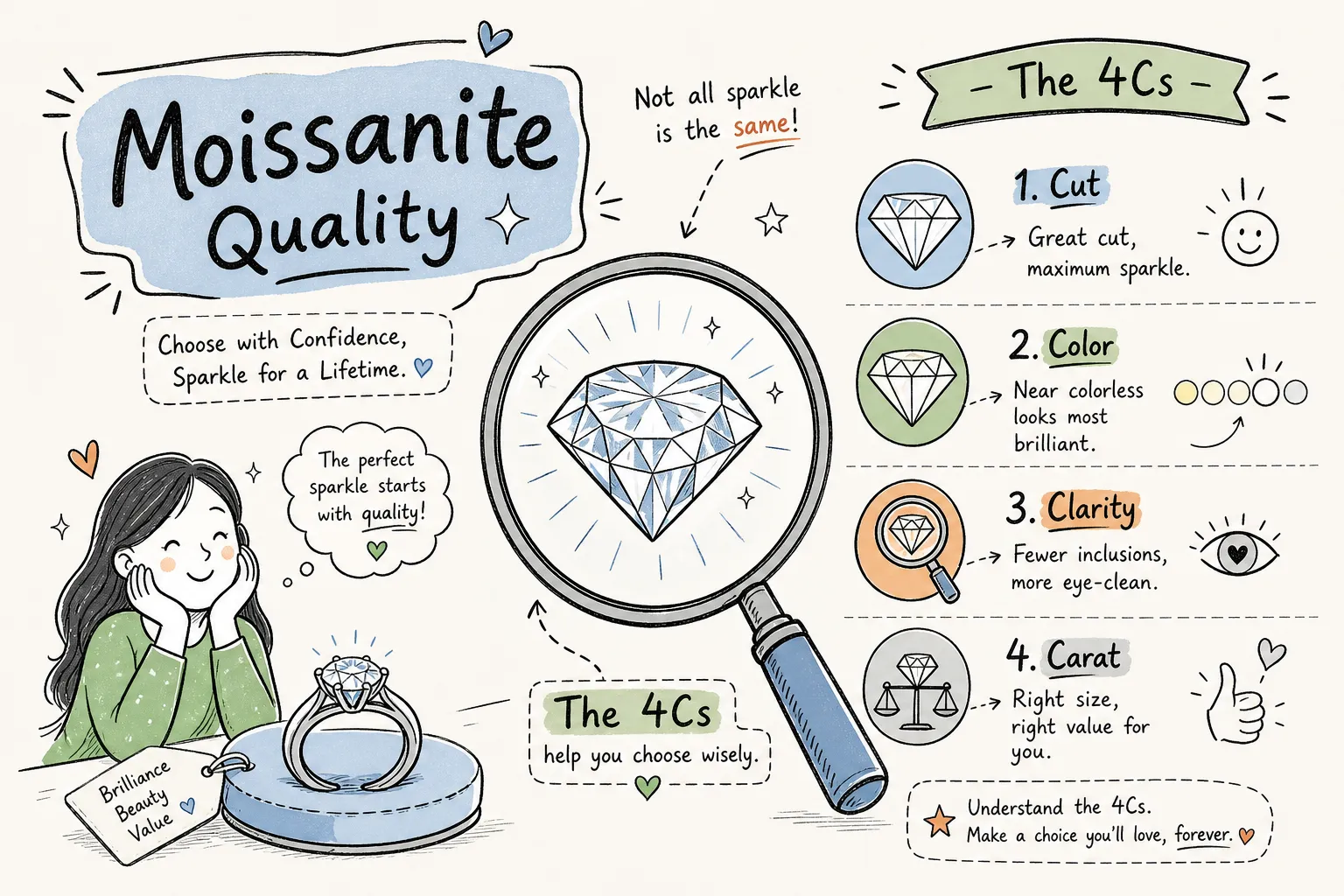
Moissanite quality determines whether a stone looks extraordinary in photographs and just as good on your finger in real life, or whether it leans dull under different lighting. At Nura Lab, we believe the key to choosing with confidence is understanding the four factors: colour, clarity, cut, and carat.
This guide walks you through each quality factor, explains which grades to prioritise for an engagement ring, and gives you concrete questions to ask before you buy. For more context, visit our Moissanite Education Hub.
What the 4Cs Actually Measure in Moissanite
While moissanite does not have an independent grading body like the GIA, reputable sellers map stones to the D-Z colour scale and FL-to-I clarity scale. However, moissanite behaves optically differently from diamonds. For a deep dive into these differences, see our Moissanite vs Lab Grown Diamond comparison.
1. Color: Icy White vs. Natural Warmth
D-F (Colourless): Provides an icy, neutral white appearance. Best paired with white gold or platinum.
G-H (Near-Colourless): A practical choice that reads as white in most lighting but offers a slight warmth that integrates beautifully with yellow or rose gold settings.
2. Clarity: The "Eye-Clean" Benchmark
While lab-flawless (FL/IF) stones exist, the practical benchmark for an engagement ring is "eye-clean." VVS and VS grades show inclusions only under extreme magnification. To understand these terms better, see this resource on moissanite grading explained.
3. Cut: The Engine of Sparkle
Cut is the most important factor. Because moissanite has a higher refractive index (2.65) than diamond, a well-proportioned cut is essential to harness that light without creating a distracting "rainbow-flash" effect. For tips on choosing the best style, see moissanite cuts revealed.
Managing "Fire"
Moissanite's fire is 2.4 times stronger than diamond's. The Round Brilliant cut manages this best by balancing brightness and fire. Well-cut ovals are great but require precision to avoid bowtie shadows.
4. Durability: Built for Daily Wear
Rating 9.25 on the Mohs scale, moissanite is harder than sapphire and second only to diamond. It resists scratching from keys and everyday surfaces and won't cloud over time. For more on how it holds up, read about the durability of moissanite.
At Nura Lab, every ring includes a lifetime warranty and free resizing as standard. We use solid 14K/18K gold or platinum to ensure the setting lasts as long as the stone.
Five Questions to Ask Before You Buy
- Does the stone map to the D-Z diamond scale?
- What is the specific cut grade (Excellent/Ideal)?
- Can I see a video of the actual stone (not a stock image)?
- Is the setting solid gold/platinum or just plated?
- Does the warranty include resizing and maintenance?
For more specific queries, you can book a 15-minute Quick Jewellery Question with our team.


